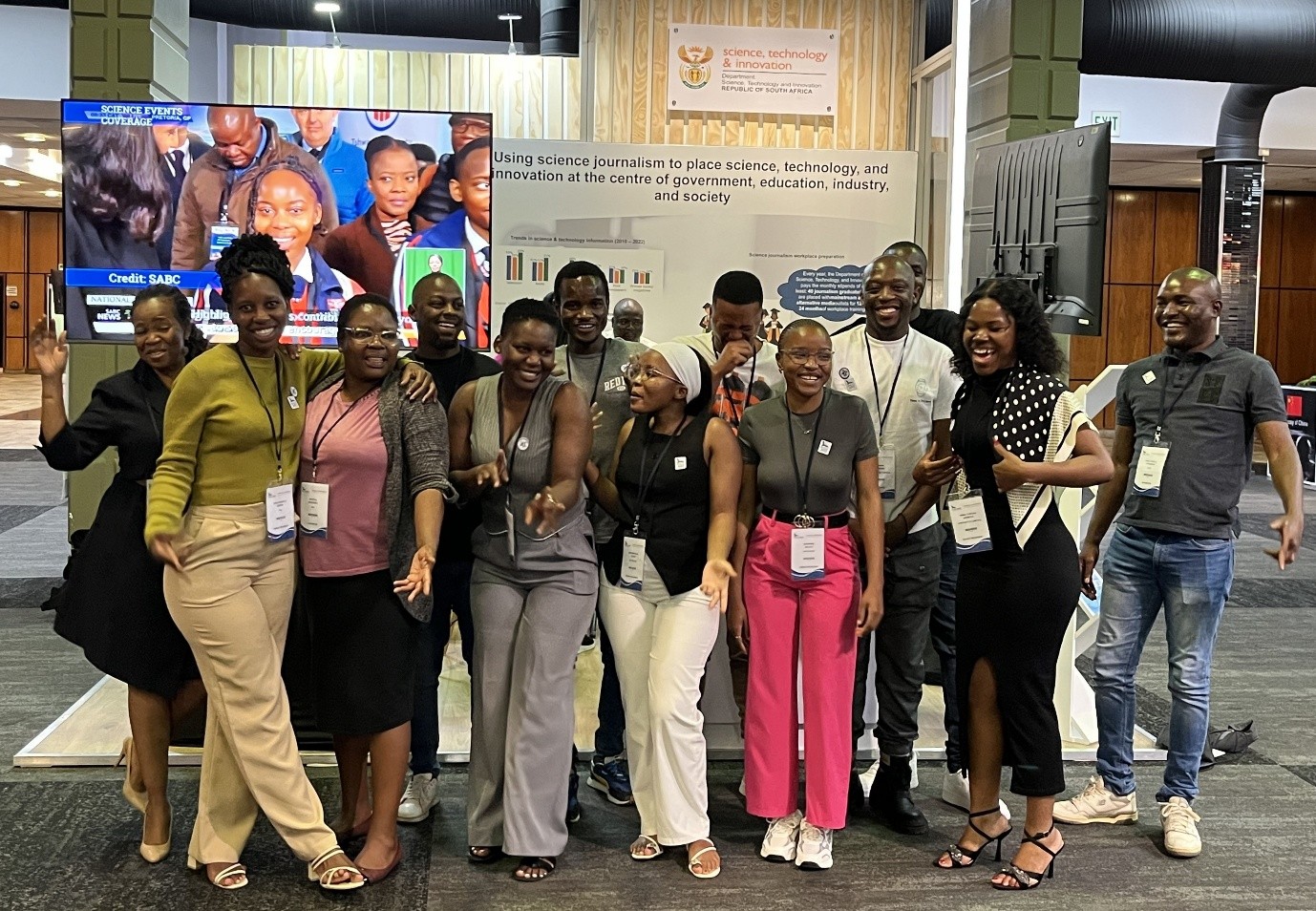
Image: DSTI/NRF-SAASTA journalist’s interns at World Conference of Science Journalists
The Department of Science, Technology and Innovation (DSTI) through the South African Agency for Science and Technology Advancement, selected five science journalism interns from mainstream media and community media and five Postgraduate Diploma Science Communication graduates to attend the World Conference of Science Journalists (WCSJ) which took from 01 December-5 December at the Council for Scientific and Industrial Research International Convention Centre in Pretoria, under the theme “Science Journalism and Social Justice: Journalism that Builds Understanding and Resilience.”
The conference was organised by the South African Science Journalists’ Association (SASJA) and the Science Diplomacy Capital for Africa (SDCfA) – an initiative of the DSTI, in collaboration with the Council for Scientific and Industrial Research (CSIR). The Department has invited five science journalism interns to participate in the conference.
The WCSJ provided science journalists and stakeholders with a valuable platform to connect, share ideas and information, engage in meaningful debates and discussions, and explore how science journalism can help build human resilience in the face of today’s global challenges.
Some of the reflections from the science journalism interns:
“I was thrilled to attend the International Conference on Science Journalism in Pretoria, and I must say it was an incredible experience! The conference offered a unique platform to connect with fellow journalists, scientists, and experts in the field, and I was able to gain valuable insights into the latest trends and best practices in science communication. The sessions were engaging, and the discussions were thought-provoking – it was amazing to see how science journalism is pushing boundaries and making an impact,” said Muofhe Baloyi, a science journalist intern at Univen FM. “What really struck me was the passion and dedication of the people I met, and the opportunity to learn from their experiences was truly enriching. I’m grateful for the connections I made and the knowledge I gained, and I’m excited to apply these takeaways to my own work. Overall, it was an absolute pleasure to be part of this event, and I’m so glad I had the chance to be there!”
“Attending this week’s International Conference on Science Journalism in Pretoria was a truly meaningful and inspiring experience for me. It offered a rare opportunity to connect with leading voices in science communication, learn from groundbreaking research, and reflect deeply on how accurate, accessible, and ethical science journalism can shape communities and influence public understanding. Throughout the conference, I was exposed to new perspectives, innovative storytelling approaches, and thoughtful discussions on how to bridge the gap between science and society,” said Sanele Zondi, a science journalist at Power FM. “What stood out most was how different science journalists from across the country and beyond shared the stage to offer guidance on making science more relatable to everyday people. They spoke openly about the challenges they face — from limited resources to public mistrust — and shared practical advice on how the media can better approach science stories with clarity, responsibility, and creativity. Hearing their experiences, struggles, and solutions gave me a deeper appreciation for the work that goes into telling science stories that truly matter.
“Being part of these conversations broadened my worldview, sharpened my sense of responsibility as a communicator, and strengthened my commitment to producing work that is both impactful and grounded in truth. The experience reminded me of the importance of creating inclusive spaces where science can be discussed openly,” added Zondi.
“Science journalism shaped my entire experience at the WCSJ. The event was an eye-opener that exposed me to the depth of knowledge shared by reporters from different countries. The sessions were insightful and pushed me to rethink how you communicate complex research in a clear and responsible way. I learned how you link evidence to lived experience, how you question weak narratives, and how you report with accuracy instead of relying on rewritten press releases. Several speakers stressed scientists deserve reporting that reflects the full value of their work, and that you carry a duty to represent their findings with care, context and independent verification,” said Warren Engelbrecht, a science journalist at the SABC.
“This gathering brings together science journalists, communicators, and science leaders to exchange ideas, strengthen the profession, and explore how science journalism can help build a resilient, well-informed society,” concluded Nobuhle Zozo, a science journalist at Voice of Wits.
The conference had a positive impact on the interns, and this experience will shape them to become excellent science journalist in the future.
 The South Africa Agency for Science and Technology Advancement (SAASTA) is a business unit of the




 Tel: +27 (0)12 392 9300