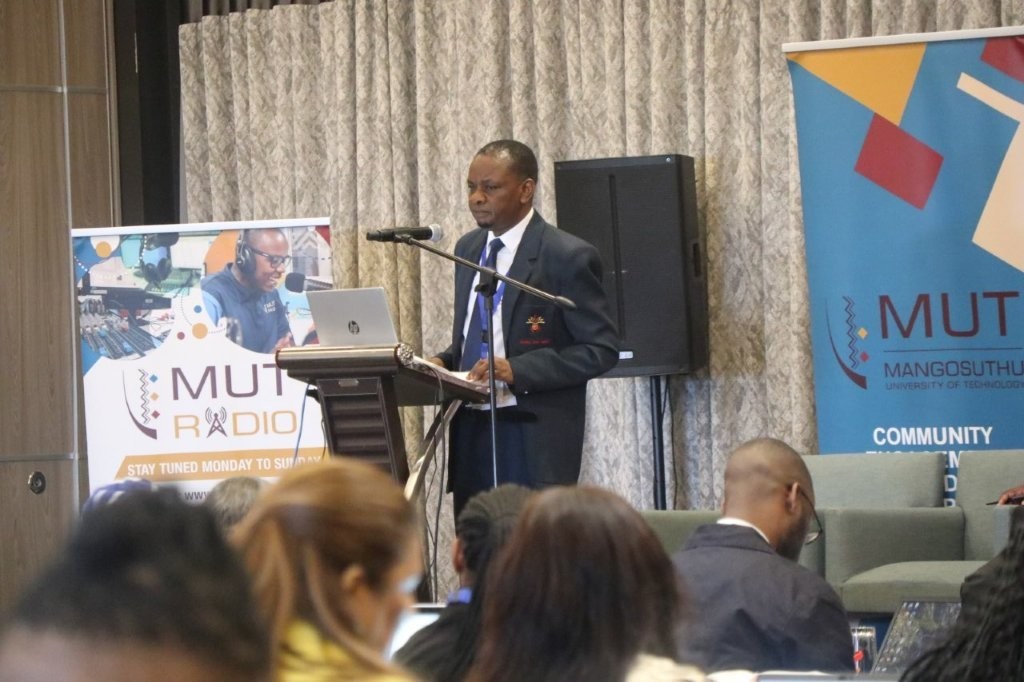
Image: Scholarship of Engagement (SoE) conference hosted by the Mangosuthu University of Technology (MUT)
NRF-SAASTA participated in the inaugural Scholarship of Engagement (SoE) conference hosted by the Mangosuthu University of Technology (MUT) from the 18-20 November 2025 at the Coastlands Hotel and Resorts in Durban, KwaZulu Natal. Through funding from the Department of Science, Technology and Innovation, NRF-SAASTA sponsored the SoE conference thereby demonstrating commitment to citizen-driven research that enable universities to pursue the community engagement mandate.
Held under the theme “Bridging the Knowledge Gap in Advancing the Scholarship of Engagement for Maximum Societal Impact”, the conference focused on three core objectives: to share best practices in integrating the three pillars of higher education (community engagement, learning and teaching, and research) across all disciplines; developing practical approaches for the integration; and contributing to a body of knowledge that elevate the SoE.
The event opened with an address by MUT Vice-Chancellor and Principal, Professor Nokuthula Sibiya. This was followed by a keynote address delivered by Professor Joseph Francis of the University of Venda (UNIVEN), titled “Closing the knowledge gap: Harnessing the Scholarship of Engagement as a strategic vehicle for inclusive community empowerment.”
Professor Francis attributed the existence of the knowledge gap, amongst other reasons, to the differences between academic knowledge and the lived experiences of communities. “You have brought answers to questions that we never asked”, he said, noting the nature of extractive scholarship often practiced by other institutions and academics.
In addition to challenges such as power dynamics and fragmented policy practice in research, Professor Francis identified capacity issues not only in the communities but amongst academics as a barrier to the advancement of the SoE. Drawing on UNIVEN’s work in localising sustainable development goals through citizen-driven research, he urged universities and scholars to ensure research agendas are co-designed and co-developed with communities and to redistribute power rather than assigning tasks to community members during the engagement processes.
Across three days, scholars, practitioners, students, communities and private organisations participated in breakaway sessions exploring sub-themes such as conceptual and multidisciplinary perspectives on SoE; practical approaches for the implementation of SoE for maximum societal impact/practical and implementation challenges for integrating community engagement into teaching and learning, and research; indigenous knowledge systems and their role in enhancing SoE; and community engagement as a vehicle towards community development.
Presenters shared their experiences of pursuing engagements with communities, citing several positives such as the institutions’ success in developing modules dedicated to the SoE, producing socially responsible graduates (e.g. 21st century engineer: beyond technological proficiency), consensus on the conceptual anchors that drive the SoE, and equipping communities with digital storytelling skills for narrative the impactful stories from academic and community partnerships.
However, presenters and participants shared concerns on the continued peripheral positioning of the SoE, that community engagement is not a funded mandate in the higher education landscape and the incompatibility of the knowledge that students bring to the communities, which is often rigid in comparison to the ‘fluid’ nature of knowledge that exists in the communities.
Between sessions, participants engaged in workshops, panel discussions and poster presentations. Besides the funding support for the conference, NRF-SAASTA exhibited at the conference, engaging delegates on the DSTI and NRF-SAASTA initiatives in engaged research and sharing resources, i.e. NRF engaged research framework and the case studies booklets, and enjoyed networking opportunities.
 The South Africa Agency for Science and Technology Advancement (SAASTA) is a business unit of the




 Tel: +27 (0)12 392 9300