
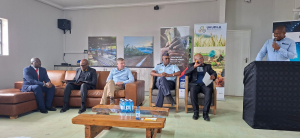
Image: Mr Shadrack Mkansi NRF-SAASTA Manager, Public Engagement Platforms (PEP) at the Commemoration of Human Rights Day in Grabouw.
The community of Grabouw recently hosted an early commemoration of Human Rights Day, bringing together a diverse group of stakeholders from across the science community, higher education institutions, government departments, and the local community. The gathering created a platform for dialogue and reflection on the role of science in advancing human rights and improving the quality of life in communities.
Commemorated annually on 21 March in South Africa, Human Rights Day honours the sacrifices made in the struggle for democracy and serves as a reminder of the importance of protecting the rights and dignity of all citizens. Within the scientific context, the human right to science refers to the right of every individual to benefit from scientific progress and from the protection of the moral and material interests resulting from any scientific, literary, or artistic work of which they are the author. In the South African constitutional framework, this principle aligns with broader rights, including access to information, education, healthcare, food, water, and social security.
Held on 14 February 2026 at Kaapschon Boerdery, an apple and pear farm in the Western Cape, the event created a unique opportunity for the Grabouw community to explore how science contributes to societal wellbeing and the protection of fundamental human rights. By situating the discussion within a community setting, the programme highlighted the practical and transformative role that science plays in everyday life.
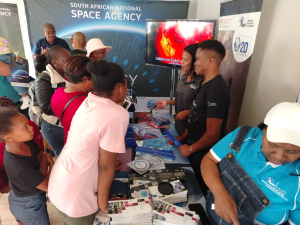
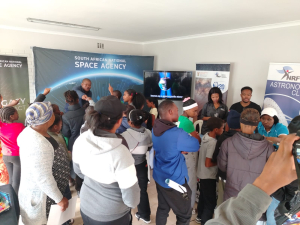
The programme featured an interactive exhibition alongside a participatory dialogue session that included a panel discussion and a keynote address. Professor Amanda Gouws of Stellenbosch University delivered the keynote address, highlighting the contribution of the social sciences to the advancement of other scientific disciplines and to the broader wellbeing of societies.
Contextual understanding of environmental, health, social and behavioural dynamics within communities informs government interventions in service delivery, creates entrepreneurial opportunities, and strengthens research and innovation ecosystems, noted Prof Gouws.
Panellists further emphasised the importance of science in addressing societal challenges and supporting the protection of human rights through informed policy and technological advancement. Denel CEO, Mr Tsepo Monaheng, highlighted the need for communities to appreciate and engage with the scientific infrastructure and facilities available within the country, noting that awareness and access are key to unlocking opportunities for development.
Adding a national security and innovation perspective, Major General Mathebula of the South African Air Force reflected on the role of space science and related operations in safeguarding South Africa’s security while also contributing to economic growth and technological advancement.
Associate Professor Clement Nyirenda, Director of the eResearch Office at the University of the Western Cape (UWC), focused on the importance of nurturing the next generation of scientists by mentoring young people and encouraging them to pursue careers in science, technology, engineering and mathematics (STEM) fields. Strengthening pathways into STEM, he noted, remains critical for building a knowledge-based economy and ensuring inclusive participation in scientific advancement.
The event also highlighted the transformative potential of science within the agricultural sector. Mr Aldrin October, owner of Kaapschon Boerdery, shared reflections on how science-based farming practices have created opportunities for learning, skills development, and community upliftment within the area. His remarks emphasised how agriculture, innovation, and education intersect to support sustainable livelihoods.
A key highlight of the day was the official opening of an Early Childhood Development (ECD) centre on the farm. The facility will serve as an important learning space and community resource, particularly for young children living and learning within the farming community.
In concluding the event, Mr October reminded attendees that science is not only about research and innovation but also about advancing human dignity and equality. By empowering communities with knowledge and opportunity, science continues to serve as a vital driver of sustainable development and social progress.
Through dialogue, collaboration, and community engagement, the Grabouw Human Rights Day commemoration demonstrated how science can play a meaningful role in strengthening democratic values and expanding opportunities for all.

 The South Africa Agency for Science and Technology Advancement (SAASTA) is a business unit of the




 Tel: +27 (0)12 392 9300

