
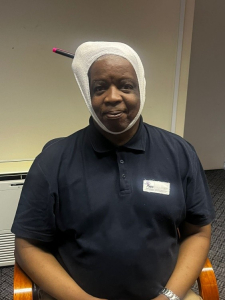
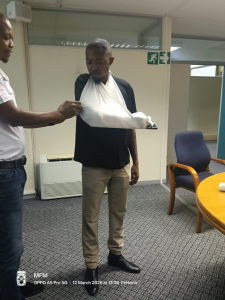
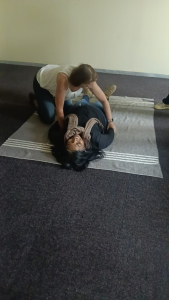
Image: The serious business of First Aid in progress. The NRF-SAASTA team learned that it takes teamwork, timing, and just enough pressure to save a life.
NRF-SAASTA’s first aid team recently returned to the classroom to refresh and strengthen their Level 1-3 First Aid certification, ensuring that they remain ready to respond effectively when it matters most. While first aid training is serious business, the sessions also reminded everyone that learning life-saving skills can be both practical and surprisingly entertaining.
The training covered a wide range of emergency response scenarios, from treating cuts and burns to managing fractures, choking, and more serious medical emergencies. Participants were guided through the correct procedures for cardiopulmonary resuscitation (CPR), spinal injury management, bleeding control, and patient assessment. These exercises reinforced the importance of remaining calm, methodical, and confident when responding to emergencies.
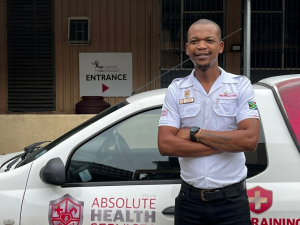
The sessions were facilitated by Thabitso Khumalo from Absolute Health Services, whose approach played an important role in making the training both rigorous and engaging. Thabitso was strict and uncompromising when it came to correct procedures and safety standards, yet he balanced this with kindness, patience, and deep knowledge. The NRF-SAASTA team did not hold back when presenting unusual and sometimes challenging real-life scenarios. Thabitso responded thoughtfully to each one, drawing on both experience and sound medical principles to guide the discussion.
This ability to explore difficult questions and realistic situations made the training particularly meaningful. First aid is not only about memorising steps from a manual. It is also about understanding how to respond to unpredictable situations. The discussions often touched on the science behind medical responses, helping participants understand not only what to do, but also why it matters.
As expected, the practical demonstrations proved to be the highlight of the training. Colleagues quickly discovered that applying a triangular bandage neatly is far more challenging than it looks, and that immobilising a “patient” who insists on laughing is not part of the standard training manual. At one point, volunteers were wrapped, bandaged, and carefully positioned in ways that drew comparisons to modern art installations rather than textbook medical scenarios.
Despite the light-hearted moments, the training served as an important reminder of the responsibility carried by workplace first aiders. In an emergency, the first few minutes are often critical. Having trained colleagues nearby can make a significant difference while waiting for professional medical services to arrive.
The refresher also reinforced key principles such as scene safety, rapid assessment, and effective teamwork. First aiders practised working together, communicating clearly, and supporting each other in simulated emergency situations. These exercises help ensure that when a real incident occurs, the response is coordinated and effective.
NRF-SAASTA remains committed to maintaining a safe working environment for both staff and visitors. By investing in continuous training, the organisation ensures that its first aid team remains equipped with up-to-date knowledge and practical skills.
 The South Africa Agency for Science and Technology Advancement (SAASTA) is a business unit of the




 Tel: +27 (0)12 392 9300


