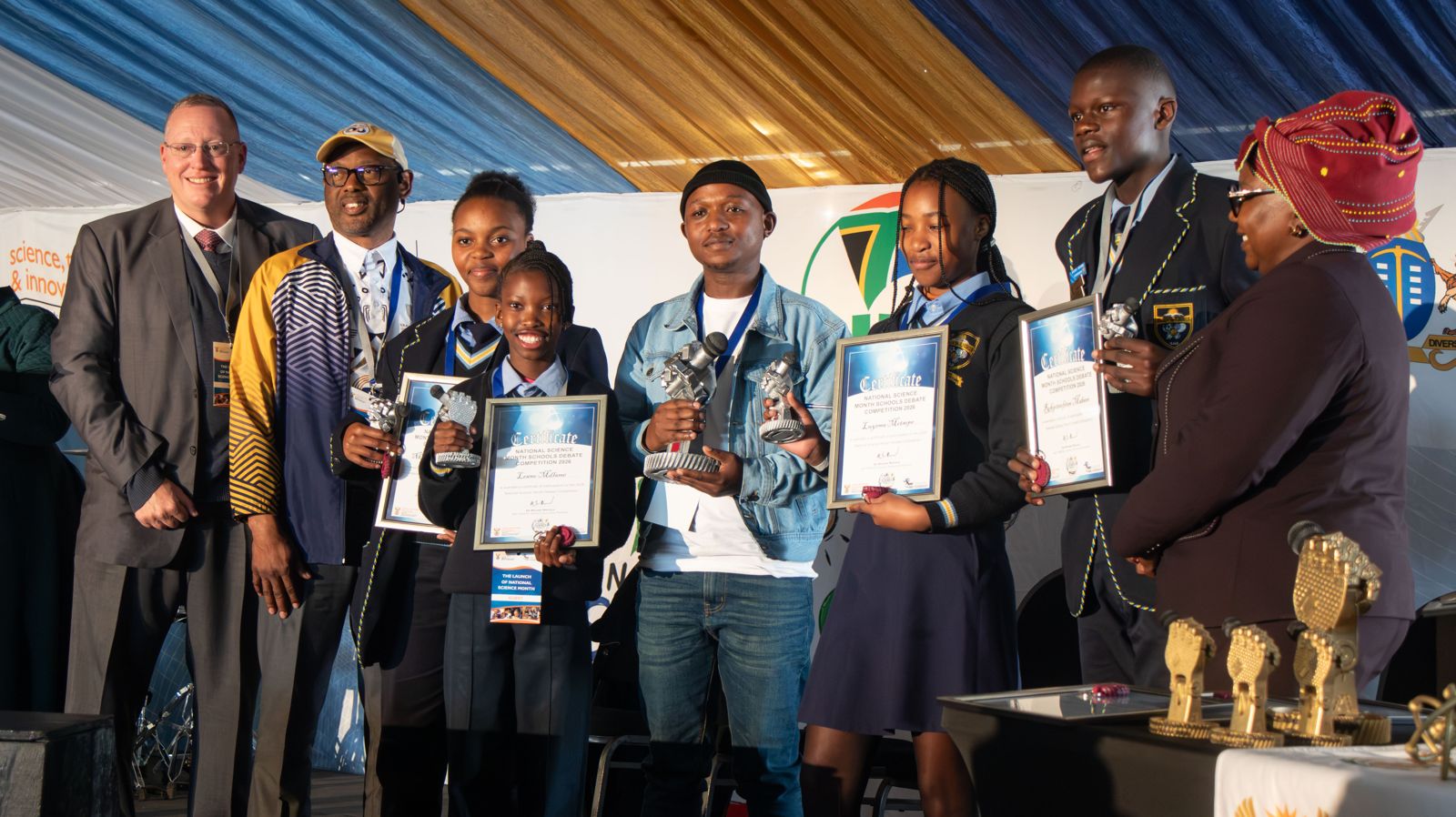
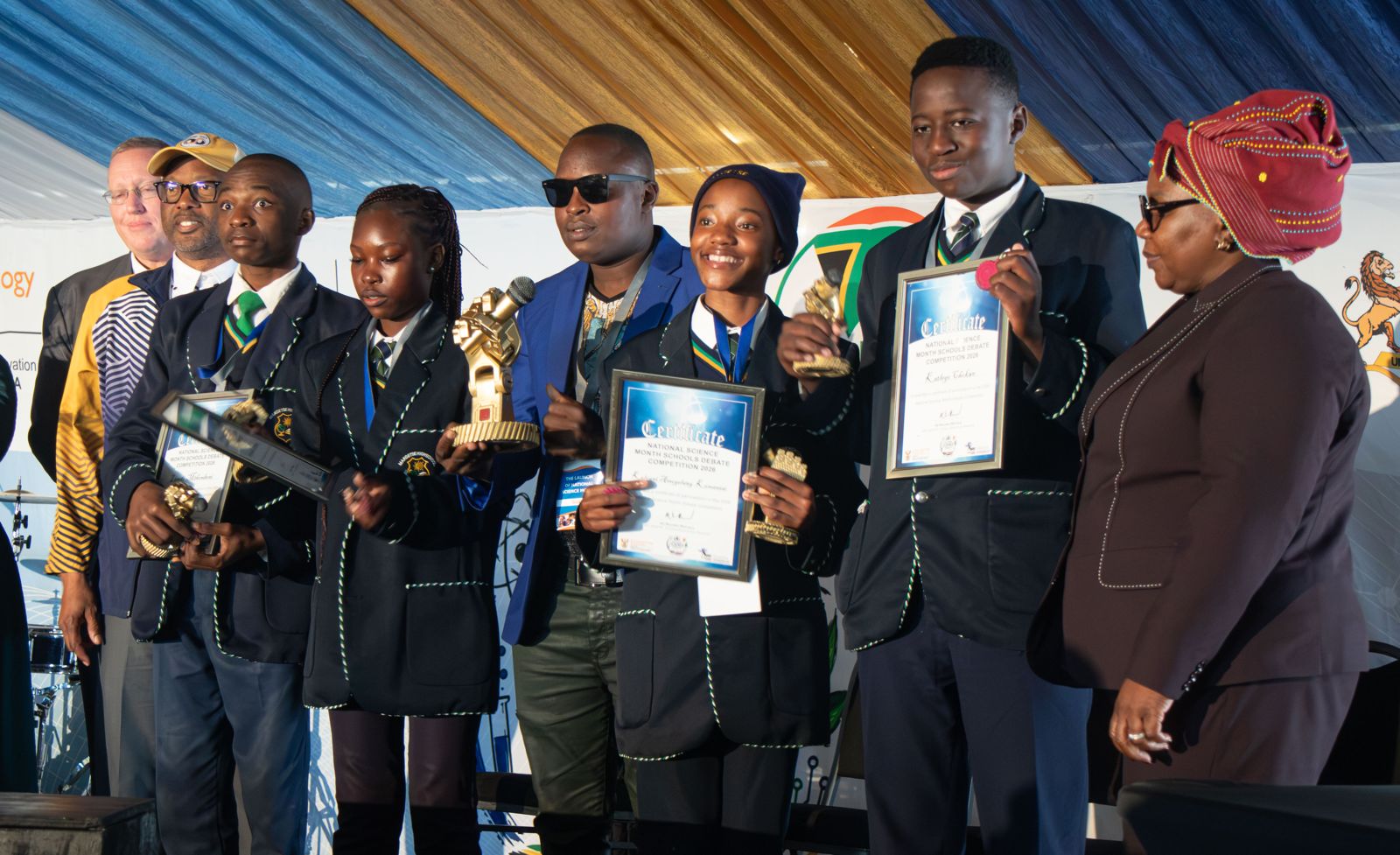
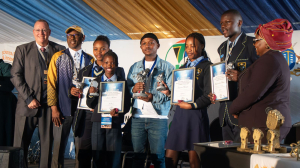
Image: The winning debate team from Makgetse Secondary School in the Tshwane education district pose proudly with their trophies and certificates. They received their award from the Deputy Minister of Science, Technology and Innovation, Dr Nomalungelo Gina, (right) during the National Science Month launch at the Vaal University of Technology on 4 July 2026.
South Africa’s future scientists, engineers, innovators and technology leaders are not only being developed in laboratories and classrooms—they are also finding their voices on debating stages where complex scientific issues are explored through discussion, evidence and critical thinking.
As part of its ongoing commitment to building a scientifically literate society, the Department of Science, Technology and Innovation (DSTI), through the South African Agency for Science and Technology Advancement, a business unit of the National Research Foundation (NRF-SAASTA), hosted the 2026 Gauteng Debate Competition. This brought together learners from Gauteng’s Sedibeng and Tshwane education districts to debate one of today’s most relevant technological questions:
“Artificial Intelligence (AI) has emerged as one of the key drivers of Science and Technology: Does the use of AI in learning compromise academic integrity and excellence?”
The competition forms part of the annual build-up to National Science Month and demonstrates how science engagement extends beyond textbooks by encouraging learners to analyse emerging technologies, interrogate ethical questions and develop evidence-based arguments.
Science engagement is central to South Africa’s vision of becoming a knowledge-based economy. Through its national science engagement programmes, NRF-SAASTA seeks to cultivate curiosity, stimulate public participation in science and inspire young people to pursue careers in science, technology, engineering and mathematics (STEM).
The National Science Month Debate Competition exemplifies this approach by combining scientific knowledge with communication, research, teamwork and leadership skills.
Prior to the competition, educators participated in a virtual workshop where they received guidance on the competition rules, judging criteria and supporting resource materials. This ensured that learners were well prepared to engage meaningfully with one of the defining technological developments of our time—Artificial Intelligence.
The first elimination rounds were hosted at the ArcelorMittal Science Centre in Sebokeng and Pretoria Technical High School, bringing together 29 secondary schools from the Sedibeng and Tshwane districts. Each school fielded a team of four learners who demonstrated remarkable confidence, analytical thinking and public speaking abilities while debating the opportunities and challenges presented by AI in education.
Artificial Intelligence is rapidly transforming education, healthcare, manufacturing, agriculture, finance and countless other sectors. As AI becomes increasingly integrated into everyday life, it is essential that young people understand not only how these technologies work, but also the ethical, social and economic implications they bring.
Rather than asking learners to memorise scientific facts, the debate competition challenged participants to evaluate evidence, question assumptions and appreciate multiple perspectives. These are precisely the critical thinking skills required by the scientists, researchers, engineers, entrepreneurs and policy makers who will shape South Africa’s future innovation landscape.
The competition also reflects the broader objectives of the DSTI’s Science Engagement Strategy (SES), which seeks to place science, technology and innovation at the centre of society by making science relevant, accessible and responsive to the everyday lives of South Africans.
When young people engage with contemporary issues such as Artificial Intelligence, they begin to recognise that science is not an abstract subject confined to laboratories. Instead, it becomes a practical tool for solving real-world challenges, improving communities and creating sustainable economic opportunities.
Following highly competitive regional rounds, adjudicators selected the top eight schools to advance to the second round of the competition held at the Sci-Bono Discovery Centre on 24 June 2026. Learners demonstrated exceptional preparation, confidence and teamwork as they presented compelling arguments supported by scientific evidence and logical reasoning.
The competition culminated in an outstanding final between Makgetse Secondary School from Tshwane and Khanya-Lesedi School of Specialisation from Sedibeng. Both schools showcased the calibre of talent that exists within South Africa’s public education system, ultimately highlighting the importance of investing in science engagement initiatives that nurture future innovators.
Makgetse Secondary School was announced as the overall winner during the National Science Month Launch at Vaal Univesirty of Technology on 4 July 2026, with Khanya-Lesedi School of Specialisation securing second place.
While the awards recognised excellence in debating, every participating learner emerged with valuable experience in research, collaboration, communication and scientific reasoning—skills that will serve them throughout their educational and professional journeys.
South Africa’s future prosperity depends on developing a workforce equipped with the knowledge and skills needed to thrive in a rapidly changing world driven by science, technology and innovation.
Programmes such as the National Science Month Debate Competition contribute directly to this goal by exposing learners to contemporary scientific issues while creating opportunities to discover the diverse careers available within STEM fields. Whether learners aspire to become researchers, software developers, environmental scientists, medical professionals, engineers, science communicators or entrepreneurs, early exposure to scientific discussion helps broaden their understanding of what is possible.
Importantly, these initiatives also demonstrate that science belongs to everyone – the theme of the National Science Month 2026. Regardless of background or geographic location, every young person should have the opportunity to participate in scientific discovery, innovation and informed public dialogue.
 The South Africa Agency for Science and Technology Advancement (SAASTA) is a business unit of the




 Tel: +27 (0)12 392 9300