South Africa’s economic future will depend on the scientists, engineers, innovators and technology leaders it develops today. Yet the country’s STEM pipeline remains under pressure, with too many learners leaving school without the mathematics and science foundation needed to pursue high-demand careers in engineering, information technology, health sciences, data science and advanced manufacturing. At the same time, the Department of Higher Education and Training has cautioned that declining numbers of science, engineering and technology graduates threaten South Africa’s long-term economic growth and innovation capacity.
Changing this trajectory requires more than strong classroom teaching. It requires giving young people opportunities to experience science as exciting, relevant and achievable—to spark curiosity, build confidence and help learners see themselves as future scientists, engineers, researchers and innovators. Research consistently shows that learners who participate in practical, hands-on STEM activities are more likely to develop positive attitudes towards science and consider STEM careers.
This is the vision behind the After School Science Clubs (ASSC) programme, an initiative of the National Research Foundation’s South African Agency for Science and Technology Advancement (NRF-SAASTA). By taking science beyond the classroom into engaging, learner-led environments, ASSCs are helping to cultivate the next generation of problem-solvers while strengthening South Africa’s future research and innovation pipeline.
“Every new science club represents another opportunity to unlock talent, particularly in under-served communities where access to educational enrichment opportunities has traditionally been limited,” says NRF-SAASTA’s Dr. Moloko Matlala, Manager: STEMI Education.
This vision took another significant step forward on 25 July 2026, when NRF-SAASTA, in collaboration with the South African National Biodiversity Institute (SANBI) and the Gauteng Department of Education (GDE), officially launched the Gauteng rollout of the After School Science Clubs programme to 35 schools during National Science Month at the SANBI National Zoological Garden in Pretoria.
The event brought together learners, educators and STEM stakeholders for a day of practical learning, interactive exhibitions and science engagement while preparing participating schools to establish sustainable science clubs that will continue inspiring learners long after National Science Month has ended.
The After School Science Clubs programme is coordinated nationally by NRF-SAASTA through partnerships across South Africa’s science engagement ecosystem. More than an extracurricular activity, ASSCs provide learners with opportunities to experience science through discovery and participation. Coding and robotics, engineering design challenges, environmental projects, mathematics enrichment, citizen science, competitions and career exploration all help learners develop critical thinking, creativity, collaboration and problem-solving skills that are essential in the modern economy.
Importantly, the clubs are learner-driven, with educators and mentors serving as facilitators who encourage exploration, experimentation and leadership. This model empowers learners to take ownership of their learning while building confidence and resilience—qualities that are fundamental to success in STEM disciplines.
The Gauteng launch equipped learner representatives and educators with practical guidance on establishing and managing successful science clubs. Participants received training on planning meaningful STEM activities, maintaining club records, coordinating learner participation and sustaining active clubs throughout the year. The objective was not merely to launch another programme, but to establish a strong foundation for enduring science engagement within participating schools.
A key feature of the launch was the collaboration between organisations committed to advancing STEM education and science engagement. The South African Mathematics Foundation (SAMF), South African Institution of Civil Engineering (SAICE), University of Johannesburg (UJ), Sci-Bono Discovery Centre, South African Environmental Observation Network (SAEON), Department of Forestry, Fisheries and the Environment (DFFE), Waterberg Innovation Centre, Rand Water’s Water Wise programme and SANBI all contributed interactive exhibitions, demonstrations and hands-on learning experiences.
Learners experienced STEM in action across multiple disciplines. SAICE challenged participants to design and construct bridges, introducing engineering principles through practical problem-solving, while UJ and Sci-Bono facilitated robotics activities showcasing emerging technologies. Other exhibitions exposed learners to biodiversity, environmental science, sustainability, water conservation, mathematics and scientific research, broadening their understanding of the many career pathways available within STEM.
The launch also showcased the power of peer learning through the participation of Thengwe High School, one of the programme’s established science clubs. Learners and their mentor shared their experiences with newly participating schools, demonstrating how committed educators, learner leadership and sustained participation can transform a science club into a thriving platform for discovery and achievement.
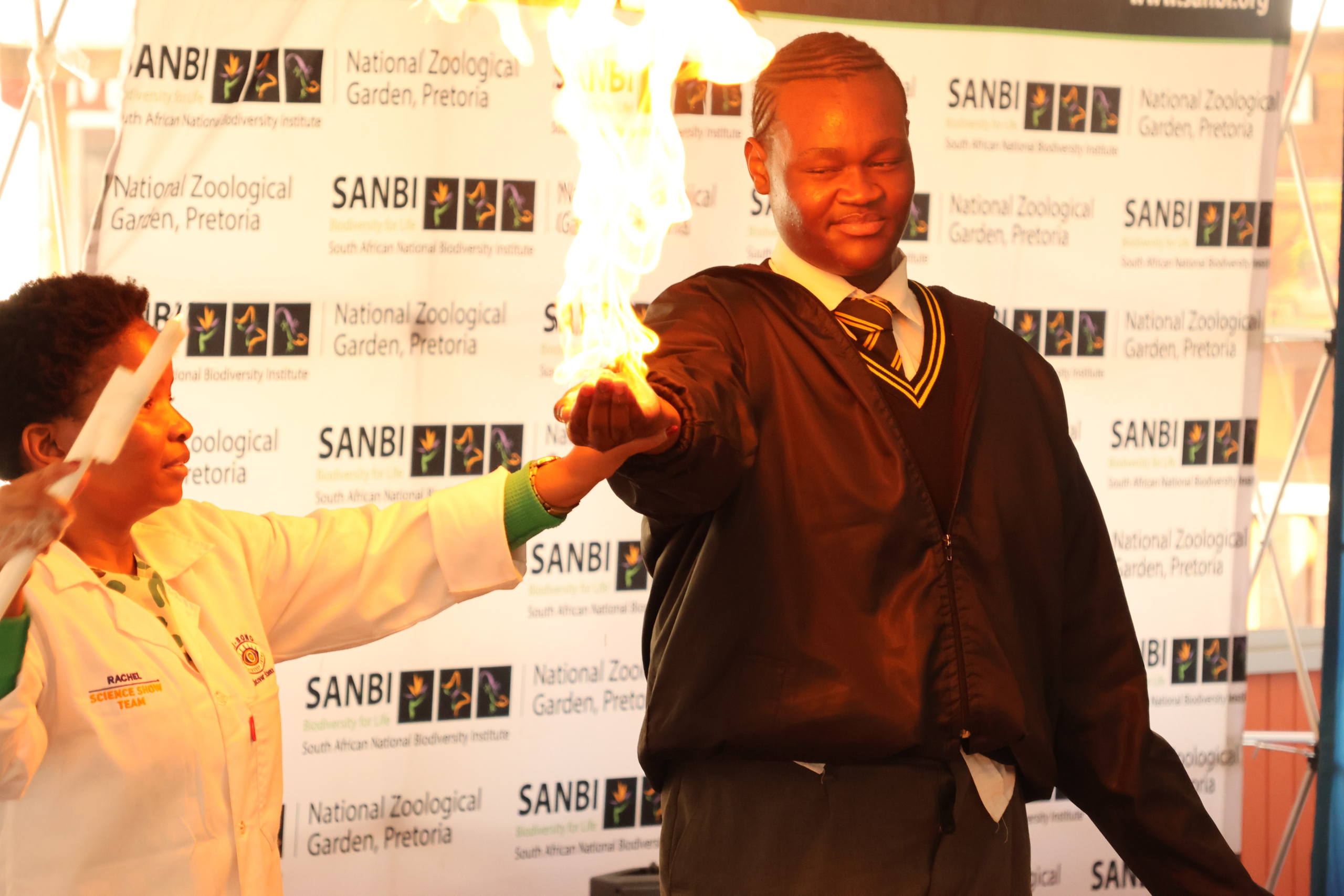
The day concluded with Sci-Bono’s interactive science show, providing an energetic finale that reinforced the excitement and accessibility of science. Together, the activities illustrated the central purpose of ASSC: bringing diverse STEM partners together to create meaningful learning experiences that inspire curiosity and encourage continued exploration.
While National Science Month provides an important catalyst for public engagement with science, initiatives such as the After School Science Clubs ensure that this momentum extends throughout the year. By embedding science engagement within schools, learners have ongoing opportunities to experiment, innovate, engage with scientists and mentors, and discover how STEM can help solve real-world challenges facing their communities and the country.
The rollout to 35 Gauteng schools marks another important milestone in expanding equitable access to quality STEM engagement. As the network of After School Science Clubs continues to grow across South Africa, so too does the country’s capacity to inspire future researchers, innovators and entrepreneurs. Through ASSC, NRF-SAASTA and its partners are not simply establishing science clubs—they are investing in South Africa’s future scientific capability, strengthening the National System of Innovation and ensuring that more young people are empowered to transform curiosity into discovery and discovery into societal impact.
 The South Africa Agency for Science and Technology Advancement (SAASTA) is a business unit of the




 Tel: +27 (0)12 392 9300