|
Where is it?
The Crade of Humankind is mainly in Gauteng with a small extension into the Northwest Province. The closest city is Johannesburg and the closest town is Magaliesburg. A drive from Pretoria or Johannesburg will take about 45 minutes.
Why is it called the Cradle of Humankind?
This area has been called the Cradle of Humankind because it has a number of sites containing the fossilized remains of some of the earliest members of the human family (early hominids), as well as stone, bone and horn tools.
What is the site like?
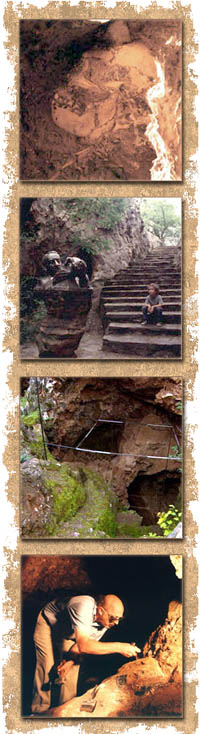
It covers 47 000 ha of land and consists of a strip of a dozen dolomitic limestone caves containing the fossillised remains of ancient forms of animals, plants and most importantly, hominids (members of the human family). The dolomite in which the caves formed developed in a warm shallow sea about 2.3 billion years ago. Some of the famous cave sites are the caves at Sterkfontein, Swartkrans and Kromdraai, as well as the Wonder Caves.
Famous fossils
Sterkfontein Caves is where Dr Robert Broom discovered the two to three-million year old hominid skull known as Mrs Ples. He began excavations at the cave in 1936 and discovered a skull of a species of early man which he initially named Plesianthropus transvaalensis, now referred to as Australopithecus africanus. Sterkfontein is also where Dr Ron Clarke discovered 'Little Foot', a near-complete fossil skeleton of a species of Australopithecus, believed to be about 3 million years old.
At Sterkfontein archaeologists have found ancient stone tools used almost two million years ago by a species of Homo. However, some of the ancient 'ape men' may also have used tools, including some made from bone, which have been found at Swartkrans. Swartkrans also yielded evidence of the first controlled use of fire by early Homo.
Ongoing research
While many hundreds of hominid fossil bones, countless thousands of animal bones and many artefacts have been excavated, work still continues in a bid to unravel our ancient past. Staff members from the Transvaal Museum (Northern Flagship Institution) and the University of the Witwatersrand are currently excavating at these sites.
Where to visit?
A section of the Sterkfontein caves is open to the public. You can view some of the ongoing excavations from a wooden walk way, join a guided which descends 60 m underground, explore the hominid exhibition hall, or look in at the laboratory where scientists work with their fossil finds.
On 2 December 2005 President Thabo Mbeki will officially open the new state-of-the-art orientation centre at Sterkfontein, the Maropeng Centre. Maropeng is a Setswana word meaning "the place where we once lived". During the construction of the visitor centre, several Stone Age tools were unearthed.
Visiting hours at Sterkfontein are from 09:00 to 16:00 every day, except Mondays. Tours of the Caves are run on the hour, and each tour takes 45 minutes. Phone (011) 668-3218 for reservations or other enquiries.
The Wonder Cave is located in the valley of Kromdraai. It has an enormous single chamber, which one enters by stairs and an elevator. It has beautiful stalagmite and stalactite formations up to 15 m high. A tour of the cave leads you along well-lit pathways, where no crawling is necessary. For enquiries about Wonder Cave, phone (0II) 957-0106
The Millennium Sundial and "A Walk through Time" at Sterkfontein
A Millennium Sundial, engraved in granite, has been installed at the Sterkfontein Caves in the Cradle of Humankind World Heritage Site. The sundial is associated with a "Walk through Time" to make people aware of the changing diversity of life over long periods of time.
The "Walk through time" consists of 15 granite slabs engraved with images of various fossils or examples of art, representing the changing diversity of life, as part of South Africa's rich palaeontological and cultural heritage. The slabs of granite are arranged in a chronological sequence from the time of the "Big Bang" to the present, which is represented by the ever-changing shadow of the sundial.
Some of the topics featured on the granite slabs of the "Walk Through Time":
- Ancient rock engravings
- The evidence for use of fire at Swartkrans
- "Mrs Ples" (a fossilised skull of Australopithecus africanus)
- The Andromeda Nebula, a neighbour of our own galaxy, the "Milky Way"
- "Little Foot" (a collection of foot bones from Sterkfontein, 3.3 million years old)
- Massospondylus, one of the world's earliest dinosaurs.
- The ancient land masses of Pangaea, Gondwana and Laurasia
- Euparkeria, a reptile that represents a distant ancestor for dinosaurs and birds.
- Thrinaxodon, a creature that lived in South Africa about 230 million years ago.
- Lystrosaurus, a mammal-like reptile that lived in the Karoo about 245 million years ago
- The coelacanth, a fish that is known to have existed about 300 million years ago in the world's oceans and is still found off the east coast of Southern Africa today.
- A rock from Mpumalanga with extremely small filamentous cyanobacteria, microfossils that are about 3 500 million years old. These fossils are among the earliest known forms of life from our planet.
- Star Cluster 47 Tucanae in relation to the Big Bang.
More information
|



 Cradle of Humankind
